
On The Go Tours
Our agents are waiting to chat to you...
Are you a Travel Agent or Customer?
Do you have an booking reference?

China's Latest Travel Updates
Everything you need to know before travelling to China in 2026
China's Latest Travel Updates
Everything you need to know before travelling to China in 2026
When do you want to go?
2026
I'm flexible
Passengers
Adults (18+)
Children (0 - 17)
Travelling to China
China is one of the most rewarding destinations in the world for multi-day travel, and getting there in 2026 is more straightforward than it has been in years. Entry procedures have been simplified, digital tools have made navigating the country easier, and international visitors are returning in significant numbers. Whether you are planning to explore the ancient streets of Xi'an, cruise along the Li River in Guilin, or take in the scale of Beijing, knowing what to expect before you arrive makes for a smoother trip. This guide covers the latest updates on entry requirements, safety, payments, and connectivity for travellers heading to China.
Entry requirements and digital arrivals
China has significantly simplified its entry process in recent years, and 2026 brings a more streamlined experience for international travellers than at any point in recent memory. From November 2025, all foreign visitors are required to complete a digital arrival card online up to 24 hours before landing. You can complete this through the official channel before departure, or fill it in using electronic devices at the airport on arrival. Paper forms remain available as a backup. All foreign nationals travelling to China for tourism, business, transit, or family visits must complete the arrival card, regardless of their nationality. A QR code generated from the completed card is typically required at immigration. There are no mandatory vaccination requirements or health declaration forms for entry into China as of 2026.
Health and safety
China is generally considered a safe destination for international tourists. Major cities including Beijing, Shanghai, Xi'an, Chengdu, and Guilin see millions of visitors each year and maintain a strong security presence in tourist areas. Petty crime rates in cities are low by international standards, though standard precautions in crowded areas apply. The US State Department currently holds a Level 2 advisory for mainland China, which primarily relates to risks for dual nationals, business travellers, and journalists rather than leisure tourists. The UK Foreign, Commonwealth and Development Office advises against all travel to areas within 50km of the Afghanistan border in Xinjiang. For most itineraries covering China's major tourist destinations, travellers report a safe and straightforward experience. Travel insurance with medical cover, emergency evacuation, and repatriation is strongly recommended for all trips to China. There is no reciprocal health agreement between the UK and China, so private medical costs fall entirely on the traveller.
Payments and money in China
China operates largely as a cashless society, and mobile payment apps are the dominant way to pay across the country. Alipay and WeChat Pay are accepted almost universally, from restaurants and hotels to street food stalls, taxis, and tourist attractions. Both apps now support international visitors: you can link a foreign Visa or Mastercard directly and pay via QR code without needing a Chinese bank account. Downloading and setting up both apps before you travel is strongly recommended, as SMS verification during registration can be unreliable on international roaming. As of 2026, the single-transaction limit for verified foreign users in Alipay has been raised to the equivalent of approximately US$5,000, covering most travel expenses. Cash remains legally accepted and merchants are required by law to accept physical RMB. Carrying a small amount of yuan as a backup is still sensible, particularly for remote areas or small vendors. Currency exchange is available at international airports, major hotels, and reputable exchange booths. International credit cards are accepted at larger hotels, airports, and chain stores, but are not universally accepted at smaller businesses.
Connectivity and essential apps
China operates a restricted internet environment, meaning many commonly used apps and websites from home are not accessible without a VPN. This includes Google services, Instagram, Facebook, WhatsApp, and various news sites. Researching and setting up a reliable VPN before you arrive is advisable, as downloading one once in-country is considerably more difficult. For navigation, Amap (also known as Gaode Map) is the most reliable option locally. For getting around cities, DiDi (China's equivalent of Uber) works well and accepts mobile payments linked to international cards. Getting a local SIM card or eSIM at the airport on arrival is one of the easiest ways to ensure immediate mobile internet access. China Mobile, China Unicom, and China Telecom all offer tourist-friendly packages with data included. Having mobile internet is particularly important as it supports payment apps, transport booking, and translation tools.
Frequently asked questions
Do I need to complete a health declaration before travelling to China in 2026?
No. Health declaration forms and vaccination requirements for entry into China were removed in 2023 and remain lifted as of 2026. You do not need a negative PCR test or health code to enter China. The main pre-arrival requirement is the digital arrival card, which can be completed online up to 24 hours before you land.
What is the digital arrival card for China and how do I complete it?
From November 2025, China replaced paper arrival forms with a digital arrival card for most foreign travellers. You can complete it online through the official channel up to 24 hours before departure, which generates a QR code to present at immigration. Electronic devices and paper forms are also available at the airport if you have not completed it in advance.
Is it safe to travel to China in 2026?
China is generally a safe destination for leisure tourists, with low crime rates in major cities and a strong security presence in tourist areas. The US State Department's current Level 2 advisory primarily applies to dual nationals, journalists, and business travellers rather than tourists on standard itineraries. Standard urban precautions apply, and travel to certain areas of Xinjiang is advised against by the UK government.
Can I use my UK bank card or credit card to pay in China?
International Visa and Mastercard cards are accepted at larger hotels, airports, and chain stores but are not universally accepted at smaller businesses or street vendors. The most practical approach is to link your UK credit or debit card to Alipay or WeChat Pay before travelling, as these apps are accepted almost everywhere across the country.
Do I need to set up Alipay or WeChat Pay before I go to China?
Yes, setting these up before departure is strongly recommended. Both Alipay and WeChat Pay can be linked to a foreign Visa or Mastercard. The registration process involves SMS verification, which can be unreliable on international roaming, so completing the setup at home beforehand avoids issues on arrival.
Will my usual apps and social media work in China?
Many widely used Western apps and websites are blocked in China, including Google, WhatsApp, Instagram, and Facebook. A VPN can provide access to these services, but must be downloaded and set up before you arrive in China, as accessing VPN services from within the country is restricted. For navigation and transport, locally available apps such as Amap and DiDi work well for tourists.
Highlights of China
Our top picks of things to see and do in China!

The Great Wall
Stretching for more than 20,000km from the Yellow Sea in the eats to the Gobi Desert in the west, the Great Wall of China is known around the world and is a major factor in many people's decision to visit China. Dating back more than 2,300 years, the UNESCO-listed wall measures 7 metres in width and 6-14 metres in height with over 25,000 battlements snaking a path along precarious mountain ridges and thick forests.

See pandas in Chengdu
Known for being absolutely adorable, Great Pandas are endemic to china making it the perfect place to see them in their natural habitat. Watch them as they play, sleep and wander around their conservation sites and learn all about China's effort to increase the panda population to stop these beautiful bears from going extinct.
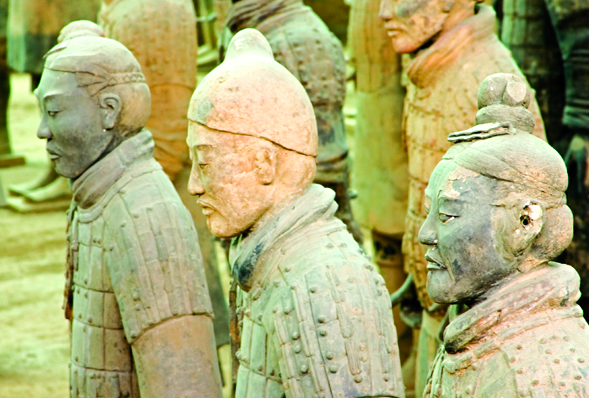
The Terracotta army in Xi'an
In 1976 three farmers near the city of Xi'an were digging a well and in doing so discovered one of China's greatest treasures - Emperor Qin's 7000-strong terracotta army. Believed to have been made 2200 years ago these life-size warriors stand in military formation in excavated pits under the cover of a modern protective hanger. Made of local clay, no two faces are alike – each is said to be an individual portrait.

Beijing
Capital of the People’s Republic, Beijing is China’s political, economic and cultural centre. With a chequered history, Beijing was established in 1045 BC and for 800 years served as the capital of several dynasties. At first glance Beijing can appear as nothing more than a modern cosmopolitan city with soaring skyscrapers, sprawls of apartment blocks and a crisscross of freeways. But hidden amid the concrete and glass one can still find remnants of the city’s past and evidence of traditional Chinese culture still practised today.

Shanghai
Buzzing with energy and activity from its gleaming sky scrapers all the way to its charming Old Town, the mega city of Shanghai epitomises China’s meteoric rise to global power status. Everywhere you look, there is something to do, see or buy, and you're unlikely to ever find yourself having a dull moment during your stay.

Guilin
Renowned for it’s striking, if bizarre scenery - vast areas of karst limestone outcrops that rise up from flat rice paddy fields, and beautiful pagodas, Guilin is often the subject of Chinese painting. On our tours that travel to Guilin, we will visit the enormous and dazzlingly beautiful Reed Flute Caves. The city is filled with a delicious fragrance of Sweet Osmanthus trees and indeed this is the meaning of the name Guilin - "forest of Sweet Osmanthus".